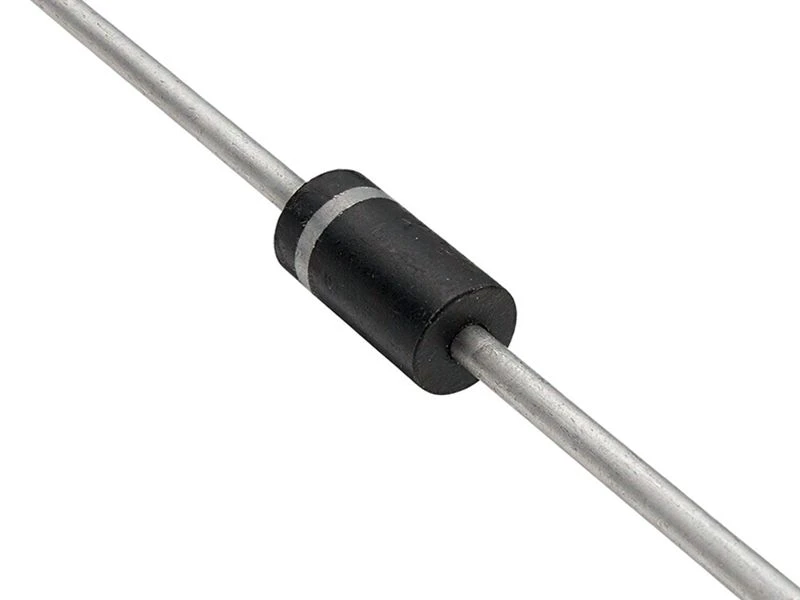
General-purpose diodes, as fundamental components in the field of electronics, play a critical role in a wide array of electronic devices-serving, for instance, as rectifiers, switches, and voltage regulators.
A diode is a semiconductor device with two electrodes; its unidirectional conductivity stems from the unique properties of its P-N junction. When a high voltage is applied to the anode and a low voltage to the cathode, the P-N junction's internal electric field-formed as electrons are driven from the N-region toward the P-region-prevents further current flow, placing the diode in a "cut-off" (non-conducting) state. Conversely, when a low voltage is applied to the anode and a high voltage to the cathode, the external voltage counteracts the internal electric field, allowing electrons to flow freely; the diode then enters a "conducting" state, permitting current to pass through.